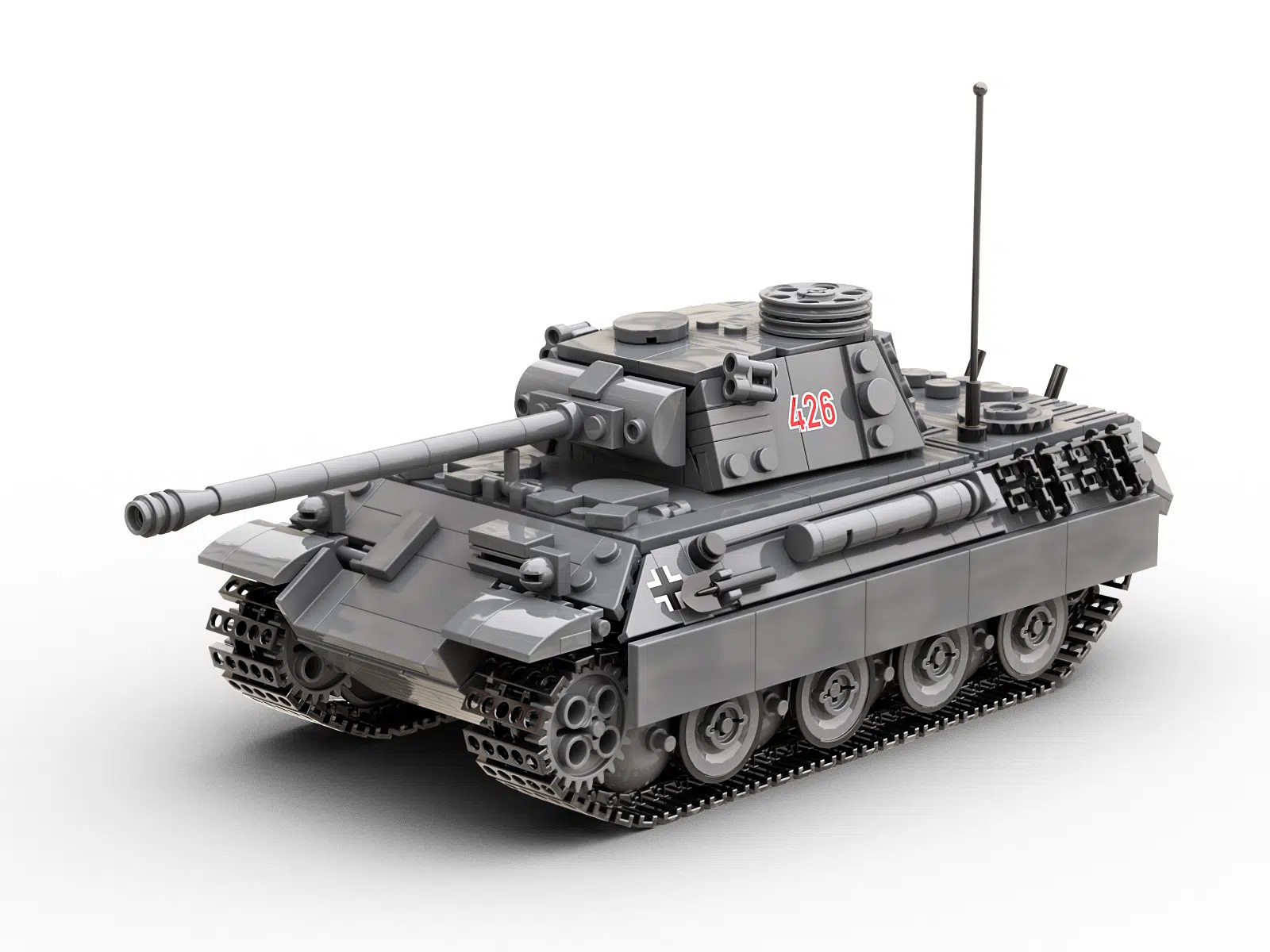
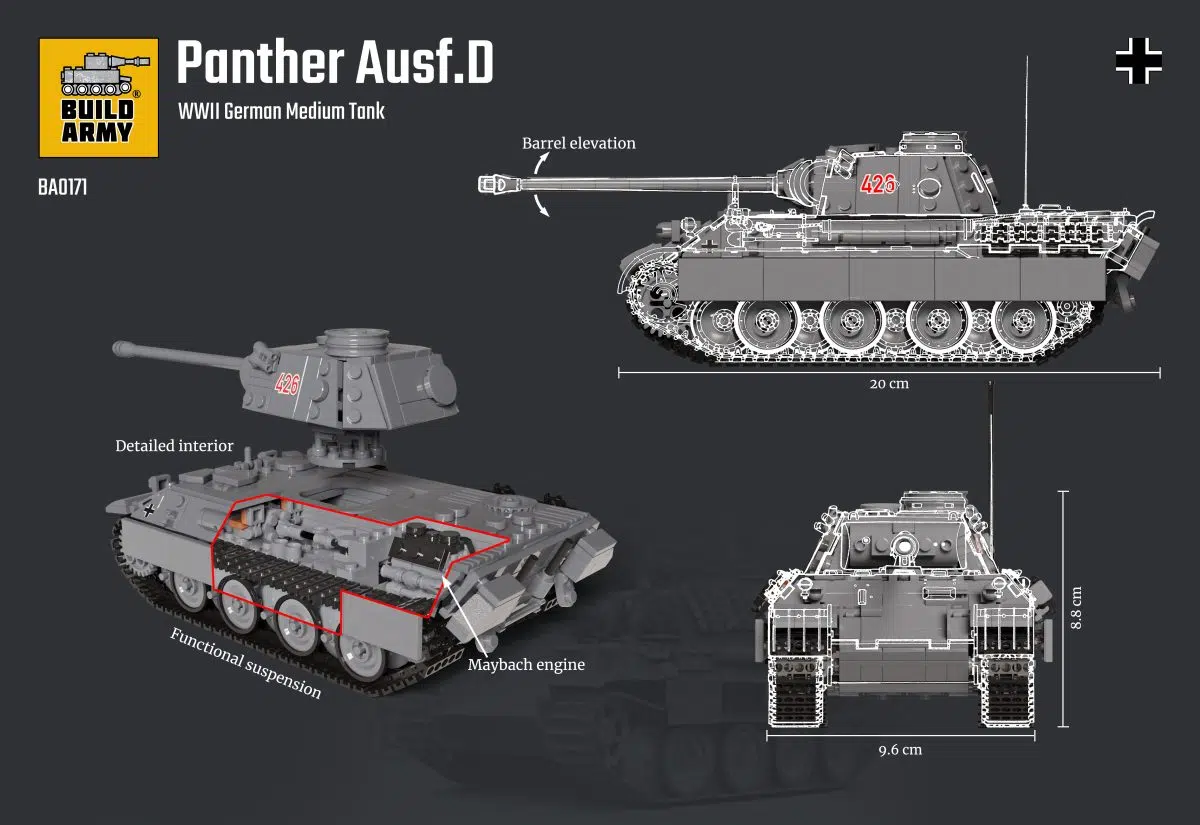
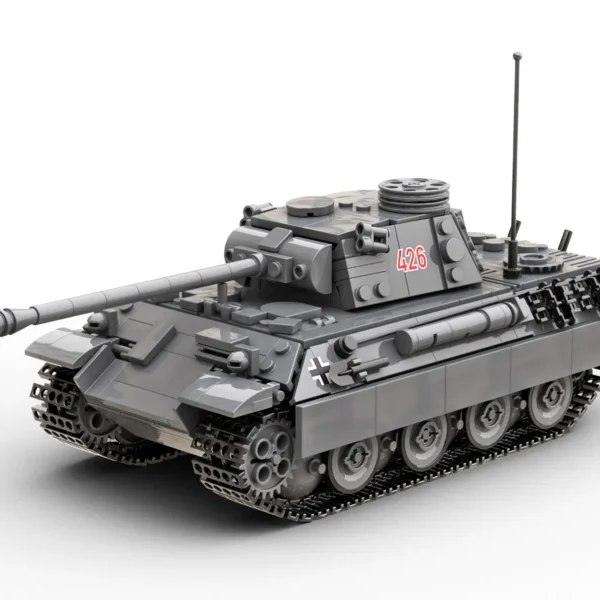
Dive into a challenging build with our Panther tank model from Buildarmy, a construction kit that not only tests your skills but also rewards you with incredible detail and historical accuracy. This 940-piece set replicates the iconic Panther tank at 1:33 scale, meticulously capturing every aspect from the signature sloped armor to the protective side skirts that contributed to its battlefield prowess.
Measuring 20 cm long, 9.6 cm wide, and 8.8 cm high, this model showcases the Panther’s advanced design, including the challenging turret with various slopes – a rewarding task for any advanced builder. The kit features a user-friendly modular design, allowing you to open parts of the hull to reveal a simple yet detailed interior representation, including seats, the transmission, and the engine.
This kit is designed for anyone who loves a building challenge. The complex assembly of the turret, combined with the overall complexity of the model, makes it a perfect choice for experienced builders or anyone looking to take their building experience to the next level.
This kit is a faithful recreation of the Panther Ausf.D, the first Panther produced (interestingly, Ausf.A was the second model). It is distinguished by the absence of a hull machine gun and the cylindrical commander’s cupola.
A brief history of Panther tanks
The Panther tank, designated Sd.Kfz. 171, is a German medium tank developed during World War II to counter the Soviet T-34 on the Eastern Front. Following studies of captured T-34s, the first prototype was built in September 1942. Despite numerous unresolved technical issues, it was rushed into service in the summer of 1943 at the Battle of Kursk. This made the Panther the most controversial tank: while some consider it one of the best tanks of WWII due to its excellent firepower and armor, others find it over-engineered and unreliable due to its mechanical problems.
Using essentially the same Maybach V12 gasoline engine as the Tiger I, the Panther had a very high power-to-weight ratio and thus better mobility. Its long-barreled 7.5 cm Kw.K 42 L/70 gun was capable of piercing the armor of most Allied tanks at long range. Although the Panther lacks the 100 mm thick frontal armor plate of the Tiger, its sloped 80 mm armor plate provided more effective protection. Despite its effectiveness, the Panther was expensive to produce, and the German army struggled to manufacture enough tanks to meet the demands of the war. Furthermore, the Panther was difficult to maintain and required significant resources to remain operational. Interestingly, the naming of Panther production variants did not follow alphabetical order: the original variant is Ausf. D, followed by the “A” and “G” variants. In total, approximately 6,000 were produced.